Development economics
Branch of economics focusing on development in low- and middle-income countries.

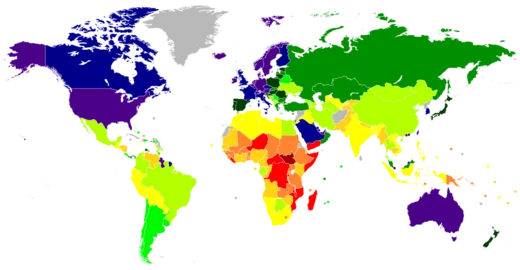
Development economics is a branch of economics that deals with economic aspects of the development process in low- and middle-income countries. Its focus is not only on methods of promoting economic development, economic growth and structural change but also on improving the potential for the mass of the population, for example, through health, education and workplace conditions, whether through public or private channels. Development economics involves the creation of theories and methods that aid in the determination of policies and practices and can be implemented at either the domestic or international level.
- field
- Economics
- known_for
- Focus on economic development in low- and middle-income countries; theories include mercantilism, economic nationalism, linear-stages-of-growth model, and structural change theory
Lore & Background
The earliest Western theory of development economics was mercantilism, which developed in the 17th century, paralleling the rise of the nation state. Mercantilism held that a nation's prosperity depended on its supply of capital, represented by bullion held by the state, and emphasized a high positive trade balance through protectionist measures such as tariffs and subsidies. Theorists associated with mercantilism include Philipp von Hörnigk and Jean-Baptiste Colbert. Following mercantilism was the related theory of economic nationalism, promulgated in the 19th century related to the development and industrialization of the United States and Germany, with key figures including Alexander Hamilton, Friedrich List, and Henry Clay.
Reader's Guide
The origins of modern development economics are often traced to the need for industrialization of eastern Europe after World War II, with key authors such as Paul Rosenstein-Rodan, Kurt Mandelbaum, Ragnar Nurkse, and Sir Hans Wolfgang Singer. Post-war, economists turned their concerns towards Asia, Africa, and Latin America, with authors like Simon Kuznets and W. Arthur Lewis analyzing not only economic growth but also structural transformation. Early theories include the linear-stages-of-growth model by W. W. Rostow, which posits five consecutive stages of development, and structural change theory by Sir Arthur Lewis, which proposes a two-sector model where surplus labor moves from agriculture to industry. Unlike many other fields of economics, approaches in development economics may incorporate social and political factors, and there is no consensus on what students should know.
Did You Know?
- Development economics focuses on low- and middle-income countries.
- The earliest Western theory of development economics was mercantilism, which developed in the 17th century.
- The linear-stages-of-growth model was formulated by W. W. Rostow in the 1950s.
Scope and Core Mission
Development economics is the branch of the discipline dedicated to understanding and improving economic life in low- and middle-income countries. Rather than treating growth as an abstract number, the field asks how the actual material conditions of ordinary people—health, schooling, working conditions—can be raised through either government programs or private-sector channels. Practitioners build theories and analytical tools that feed directly into policy design, whether that policy is crafted at the national level or negotiated internationally. The methodological toolkit is broad: some work leans on mathematical techniques like intertemporal optimization to evaluate projects, others restructure market incentives, and still others blend quantitative and qualitative approaches. Recurring themes across the literature include growth theory, the mechanics of poverty and inequality, the accumulation of human capital, and the role of institutions. What sets the field apart from much of mainstream economics is its willingness to fold social and political realities into economic planning, and its persistent refusal to settle on a single canonical curriculum for students.
Mercantilist Roots and the Rise of Economic Nationalism
The intellectual lineage of development economics stretches back to 17th-century mercantilism, which emerged alongside the consolidation of European nation-states. Mercantilists argued that national wealth was essentially a stock of bullion—gold, silver, and trade value—held by the state, and that the path to prosperity ran through maintaining a high positive trade balance. Protectionist tools such as tariffs and industrial subsidies were the preferred instruments, and colonialism was seen as a natural extension of the strategy. The 19th century brought a related but distinct current: economic nationalism. Unlike mercantilism, this tradition de-emphasized colonies in favor of domestic industrial production.
Post-War Rebuilding and the Turn Toward the Global South
Modern development economics as a recognizable discipline was born out of the urgent problem of industrializing eastern Europe after World War II. Pioneering thinkers such as Paul Rosenstein-Rodan, Kurt Mandelbaum, Ragnar Nurkse, and Sir Hans Wolfgang Singer grappled with how shattered economies could be rebuilt from the ground up. Only after this European chapter did the field's gaze shift toward Asia, Africa, and Latin America, where the challenges of underdevelopment were far more entrenched. Scholars like Simon Kuznets and W. Arthur Lewis pushed the analysis beyond simple growth accounting toward what became known as structural transformation—the deep reorganization of how an economy produces, allocates resources, and integrates its labor force. This shift was crucial: it meant that development was not merely a matter of adding more capital but of fundamentally reshaping the architecture of production and employment. The post-war generation thus established the expectation that any serious theory of development had to account for the structural realities of less-advanced economies, not just their aggregate output figures.
Rostow's Stages and the Persistent Pluralism of the Field
One of the most recognizable frameworks in the field is the linear-stages-of-growth model, first articulated by W. W. Rostow in his 1950s work The Stages of Growth: A Non-Communist Manifesto. Drawing on earlier ideas from Marx and Friedrich List, Rostow proposed that every country passes through five consecutive phases: a traditional society, the pre-conditions for take-off, the take-off itself, the drive to maturity, and finally an age of high mass-consumption. The engine of this progression is accelerated capital accumulation, fueled by both domestic and international savings channeled into investment. Simple formulations of the Harrod-Domar model were used to illustrate the mathematics behind the take-off stage. Yet for all its influence, the stages model sits within a field that resists doctrinal unity. Unlike many other branches of economics, development economics has no agreed-upon syllabus, and competing schools of thought continue to debate whether the forces at work drive households, regions, and countries toward convergence or leave them locked in persistent divergence.
Frequently Asked Questions
What is Development economics?
It is a dedicated subfield of economics that studies how low- and middle-income countries can grow their economies, restructure their industries, and raise living standards for the broad population rather than just a wealthy elite.
What core theories does Development economics include?
The canon spans mercantilism, economic nationalism, the linear-stages-of-growth model, and structural change theory, each offering a different lens on how poorer nations transition toward sustained prosperity.
How does Development economics differ from mainstream economics?
Where general economics often assumes well-functioning markets, Development economics zeroes in on the specific institutional gaps, policy constraints, and public-health or education deficits that slow growth in low- and middle-income settings.
What kinds of policies does Development economics inform?
It underpins both domestic and international interventions—ranging from public investment in schools and clinics to private-sector workplace reforms—aimed at expanding opportunity for the mass population rather than merely chasing aggregate GDP figures.
Why is Development economics important in the broader economics canon?
It supplies the theoretical frameworks and practical methods that guide governments and aid organizations in designing strategies to lift large populations out of poverty and build durable economic structures in the developing world.
More in National Economies 1-24
Elsewhere in the National Economies universe
Spotted an error? Know more?
This is a living reference — every entry is fact-audited, and reader corrections feed straight into our audit queue. Suggest an edit · See this site's audit record