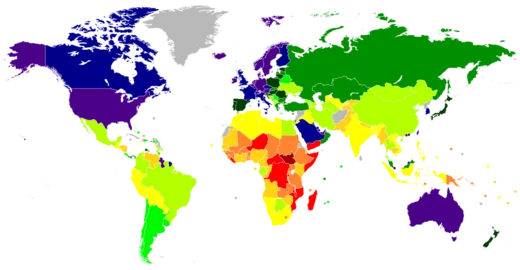
Developed country
A country with high living standards and advanced economy.

A developed country, also known as an advanced country, is a sovereign state that has a high quality of life, a developed economy, and advanced technological infrastructure relative to less industrialized nations. The criteria for classification—such as gross domestic product (GDP), gross national income (GNI), per capita income, level of industrialization, infrastructure, and standard of living—are subjects of debate among international organizations. Developed countries are contrasted with developing countries, which are in the process of industrialization or are pre-industrial and largely agrarian.
- Definition
- High quality of life, developed economy, advanced technological infrastructure
- Key criteria
- GDP, GNI, per capita income, industrialization, infrastructure, standard of living
- Global GDP share (2023)
- 57.3% of global GDP (nominal); 41.1% (PPP)
- Primary sector
- Post-industrial economies with dominant tertiary sector
- Contrasted with
- Developing countries (industrializing or pre-industrial/agrarian)
- Measurement example
- Human Development Index (HDI) combines life expectancy, education, income per capita
Lore & Background
The term 'developed country' is used by multiple international bodies, including the United Nations Department of Economic and Social Affairs (UNDESA), the World Bank, the International Monetary Fund (IMF), and the Development Assistance Committee (DAC), each applying its own criteria. The United Nations Statistics Division notes that there is no established convention for the designation, and the labels are intended for statistical convenience, not necessarily a judgment about a country's development stage. The UN Conference on Trade and Development (UNCTAD) considers that the categorization can continue, broadly comprising Northern America, Europe, Israel, Japan, the Republic of Korea, Australia, and New Zealand.
Reader's Guide
The concept of a developed country is central to global economic and political discourse, shaping aid, trade, and diplomatic relations. However, the article emphasizes that the classification is contested: different organizations (UNDESA, World Bank, IMF, DAC, Paris Club, UNIDO) use varying definitions, and the Human Development Index (HDI) adds nuance by incorporating life expectancy and education alongside income. Critics like Mathis Wackernagel call the binary labeling 'neither descriptive nor explanatory' and a 'thoughtless endorsement of GDP fetish.' The article also notes that the divide between developed and developing is largely a 20th-century phenomenon, according to some economists. The term remains useful for statistical and analytical purposes, but its limitations and the diversity among countries are acknowledged.
Did You Know?
- The first industrialized country was the United Kingdom, followed by Belgium.
- The Human Development Index does not take into account net wealth per capita or relative quality of goods.
- The UN Statistics Division states there is no established convention for designating 'developed' and 'developing' countries.
The Elusive Boundary: Defining What 'Developed' Means
The label "developed country" sounds definitive, yet the United Nations Statistics Division explicitly states that no established convention exists for designating nations as developed or developing within the UN system. The organization emphasizes that these categories exist purely for statistical convenience and carry no judgment about where a nation stands in its growth trajectory. Despite this, multiple bodies—UNDESA, the World Bank, the Development Assistance Committee, the IMF, the Paris Club, and UNIDO—each offer their own classification frameworks. The UN Conference on Trade and Development groups them broadly as Northern America, Europe, Israel, Japan, South Korea, Australia, and New Zealand. The result is a landscape where the same nation might be categorized differently depending on which institution's yardstick you consult, making the very concept of a developed country a matter of ongoing institutional negotiation rather than settled fact.
Post-Industrial Economies and Global Economic Weight
Developed nations are characterized by what economists call post-industrial economic structures, where the tertiary and quaternary sectors—services, finance, technology, and knowledge-based industries—generate more wealth than manufacturing and raw material extraction. This stands in sharp contrast to developing nations, which are still in the process of industrializing or remain largely agrarian, with some falling into the least developed category. The criteria used to assess this standing typically include gross domestic product, gross national income, per capita income, the degree of industrialization, the breadth of infrastructure, and overall standard of living. Yet which specific metrics carry the most weight, and which nations ultimately qualify, remains a subject of active debate among policymakers and economists worldwide.
Beyond GDP: The Human Development Index and Its Blind Spots
While income-based metrics like GDP per capita have long dominated discussions of national development, the Human Development Index has gained prominence as a more holistic measure. The HDI weaves together three dimensions—national income, life expectancy, and educational attainment—into a single composite score, capturing how a nation converts its economic output into tangible improvements in health and learning. However, the index has notable blind spots. It does not factor in net wealth per capita or the relative quality of goods and services available to citizens. This omission, the UN acknowledges, tends to depress the rankings of some of the world's most advanced economies, including members of the G7. The HDI thus offers a richer picture than raw income figures alone, yet it remains an imperfect lens, and its very design choices influence which nations appear at the top of the global hierarchy.
A 20th-Century Divide: Terminology, History, and Criticism
The concept of a developed country carries a long and contested vocabulary. Synonyms include "advanced country," "industrialized country," "more developed country," "more economically developed country," "Global North country," "first world country," and "post-industrial country." The term "industrialized" is itself somewhat ambiguous, since industrialization is an ongoing process without a clear endpoint. Historically, the United Kingdom was the first nation to industrialize, followed by Belgium, with the process later spreading to Germany, the United States, France, and other Western European states. Yet economist Jeffrey Sachs argues that the current sharp divide between developed and developing worlds is largely a 20th-century phenomenon. Mathis Wackernagel goes further, calling the binary labeling neither descriptive nor explanatory and a thoughtless endorsement of GDP fetish, insisting that over 200 nations all face the same natural laws while possessing unique characteristics that no two-category system can adequately capture.
Frequently Asked Questions
What is a developed country?
A developed country is a sovereign state that enjoys a high standard of living, a mature and diversified economy, and well-established technological infrastructure. It sits at the upper end of the global economic spectrum relative to nations still building out their industrial base.
How do economists decide whether a country counts as 'developed'?
The classification typically hinges on indicators like GDP, gross national income, per-capita income, degree of industrialization, and overall living standards. No single universal formula exists, so different international bodies sometimes disagree on which nations qualify.
What share of global GDP do developed countries hold?
As of 2023, developed nations account for roughly 57.3 percent of world GDP at nominal values and about 41.1 percent when measured by purchasing-power parity.
How are developed economies different from developing ones?
Developed economies are generally post-industrial, with the services (tertiary) sector making up the bulk of economic activity, whereas developing nations are still expanding their industrial base or remain largely agrarian. The distinction essentially reflects where a country sits in the industrialization timeline.
What role does the Human Development Index play in assessing developed countries?
The HDI gauges a nation's progress by combining life expectancy, educational attainment, and income into a single composite score. It helps round out the purely monetary metrics like GDP or GNI that also feed into the developed-country classification.
More in National Economies 1-24
Elsewhere in the National Economies universe
Spotted an error? Know more?
This is a living reference — every entry is fact-audited, and reader corrections feed straight into our audit queue. Suggest an edit · See this site's audit record