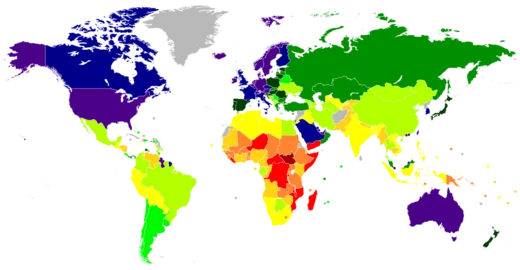
Developing country
A country with less industrialization and lower HDI than developed nations.

A developing country is a country with a less-developed industrial base and a lower Human Development Index (HDI) relative to developed countries, though this definition is not universally agreed upon. There is also no clear agreement on which countries fit this category. The terms low- and middle-income country (LMIC) and newly emerging economy (NEE) are often used interchangeably but refer only to the economy of the countries. The World Bank classifies the world's economies into four groups based on gross national income per capita: high-, upper-middle-, lower-middle-, and low-income countries. Least developed countries, landlocked developing countries, and small island developing states are all sub-groupings of developing countries. The term 'Global South' is used by some as an alternative.
- classification basis
- Gross national income per capita (World Bank)
- income groups
- High, upper-middle, lower-middle, low
- alternative terms
- LMIC, NEE, Global South
- common characteristics
- Lower access to safe water, sanitation, healthcare; higher poverty, pollution, infectious diseases
- IMF focus
- Income and other factors (e.g., advanced vs. emerging/developing), not solely financial integration
- WTO rule
- Accepts any country's self-declaration as 'developing'
Lore & Background
Developing countries tend to share characteristics often due to their histories or geographies, including lower levels of access to safe drinking water, sanitation, and hygiene; higher pollution; more tropical and infectious diseases; and generally poorer infrastructure. They also commonly have high unemployment, widespread poverty, child labour, malnutrition, a large informal economy, high crime rates, low education levels, corruption, and political instability. While many developing countries have functioning legal systems and rule of law, enforcement may be weaker than in developed nations. Access to healthcare is often low, with lower life expectancies and higher burdens of infectious diseases, maternal mortality, child mortality, and infant mortality. The effects of climate change are expected to affect developing countries more than high-income countries due to high climate vulnerability or low climate resilience.
Reader's Guide
The concept of a developing country is central to global economic and social discourse, yet it remains contested and imprecise. The World Bank's income-based classification—dividing economies into high, upper-middle, lower-middle, and low income—provides a widely used framework, but the term 'developing country' itself has been criticized as outdated and potentially disparaging. The IMF uses a different approach, focusing solely on financial integration and stability, which can lead to immediate upgrades for countries adopting the Euro regardless of other development factors. The WTO accepts any country's self-declaration as developing, leading some economically advanced nations to retain the label for preferential treatment. Development aid and the Sustainable Development Goals aim to address the many challenges faced by these countries, including poverty, disease, and lack of infrastructure. The term 'Global South' has emerged as an alternative, though it carries its own connotations. Ultimately, the classification of a country as developing reflects a complex interplay of economic, social, and political factors, with no single definition universally accepted.
Did You Know?
- The World Bank classifies economies into four groups based on gross national income per capita, re-set each year on 1 July.
- The IMF does not have a formal classification of 'developing countries' based solely on financial integration; its main classification (e.g., advanced vs. emerging/developing) considers income and other factors.
- The WTO accepts any country's claim of itself being 'developing,' even if it has become developed by almost all economic metrics.
The Elusive Definition
The question of what makes a nation developed has no single, universally accepted answer. Multiple international bodies—the United Nations Department of Economic and Social Affairs, the World Bank, the Development Assistance Committee, the International Monetary Fund, the Paris Club, and the UN Industrial Development Organization—each offer their own classification frameworks. Commonly cited benchmarks include gross domestic product, gross national income, per capita income, the degree of industrialization, the breadth of infrastructure, and overall standard of living. Yet the United Nations Statistics Division itself acknowledges that no established convention exists within the UN system for designating countries as developed or developing, noting that such labels are meant for statistical convenience rather than as a judgment on a nation's progress. The UN Conference on Trade and Development nonetheless maintains the categorization, broadly grouping Northern America, Europe, Israel, Japan, South Korea, Australia, and New Zealand into the developed camp. This patchwork of definitions means that the exact roster of developed nations shifts depending on which institution's yardstick you consult.
Beyond the Numbers: The Human Development Index
While income-based metrics like GDP per capita have long dominated the conversation, the Human Development Index has emerged as a more holistic yardstick. By weaving together national income, life expectancy, and educational attainment, the HDI attempts to capture how a country converts its economic output into tangible human well-being. The United Nations emphasizes that this approach goes beyond raw productivity, measuring how income translates into health and learning opportunities. However, the HDI is not without blind spots. It does not factor in net wealth per capita or the relative quality of goods available to citizens, a gap that some argue artificially depresses the rankings of highly advanced economies, including several G7 members.
Economic Architecture and Global Weight
Developed nations are distinguished by their post-industrial economic structure, in which the tertiary and quaternary sectors—services, finance, technology, and knowledge industries—generate more wealth than manufacturing and other secondary activities. This stands in sharp contrast to developing nations, which are still in the process of industrialization or remain largely agrarian, some falling into the category of least developed countries.
Labels, History, and Critique
The vocabulary surrounding this concept is remarkably fluid. Alongside developed country, one encounters advanced country, industrialized country, more developed country, more economically developed country, Global North country, first world country, and post-industrial country. The term industrialized carries a particular ambiguity because industrialization is an ongoing process rather than a fixed endpoint. Historically, the United Kingdom was the first nation to industrialize, followed by Belgium, with the process later spreading to Germany, the United States, France, and other Western European states. Yet economist Jeffrey Sachs has argued that the current sharp divide between the developed and developing worlds is largely a twentieth-century construction. The binary framing has drawn pointed criticism: Mathis Wackernagel has called the labeling neither descriptive nor explanatory, describing it as a thoughtless and destructive endorsement of GDP fetish that obscures the reality of over 200 distinct nations, each governed by the same natural laws yet shaped by unique circumstances.
Frequently Asked Questions
What is a developing country?
A developing country is a nation with a relatively weaker industrial foundation and a lower Human Development Index compared to developed economies. There is no single universally accepted definition, and disagreement persists over exactly which countries belong in this group.
How does the World Bank sort economies into developing versus developed tiers?
The World Bank divides national economies into four tiers—high-income, upper-middle-income, lower-middle-income, and low-income—using gross national income per capita as the measuring stick. The three lower tiers are what people commonly lump together as 'developing.'
What other terms do people use instead of 'developing country'?
You will often see the labels LMIC (low- and middle-income country), NEE (newly emerging economy), or Global South used in place of 'developing country.' These alternatives tend to focus specifically on the economic dimension rather than implying a broader developmental gap.
What common challenges are associated with developing countries?
Nations in this category typically face more limited access to safe drinking water, adequate sanitation, and quality healthcare, alongside higher rates of poverty, pollution, and infectious disease. These traits are general tendencies rather than absolute rules for every country in the group.
How does the WTO decide whether a country counts as developing?
Under WTO rules, any member nation can simply declare itself as a developing country, and that self-identification is accepted at face value. There is no external verification process or fixed income threshold the organization enforces for this status.
More in National Economies 1-24
Elsewhere in the National Economies universe
Spotted an error? Know more?
This is a living reference — every entry is fact-audited, and reader corrections feed straight into our audit queue. Suggest an edit · See this site's audit record